Can Medicare Cover Eating Disorder Treatment? - Medicare Eating Disorder Plan
Can Medicare Cover Eating Disorder Treatment? - Your Guide To Medicare (AU) Eating Disorder Plan (EDP)
Short answer: Yes. Medicare provides rebates for eating disorder treatment in hospital settings and, in private and community settings, through the Eating Disorder Plan (EDP).
What is an EDP and what does it cover?
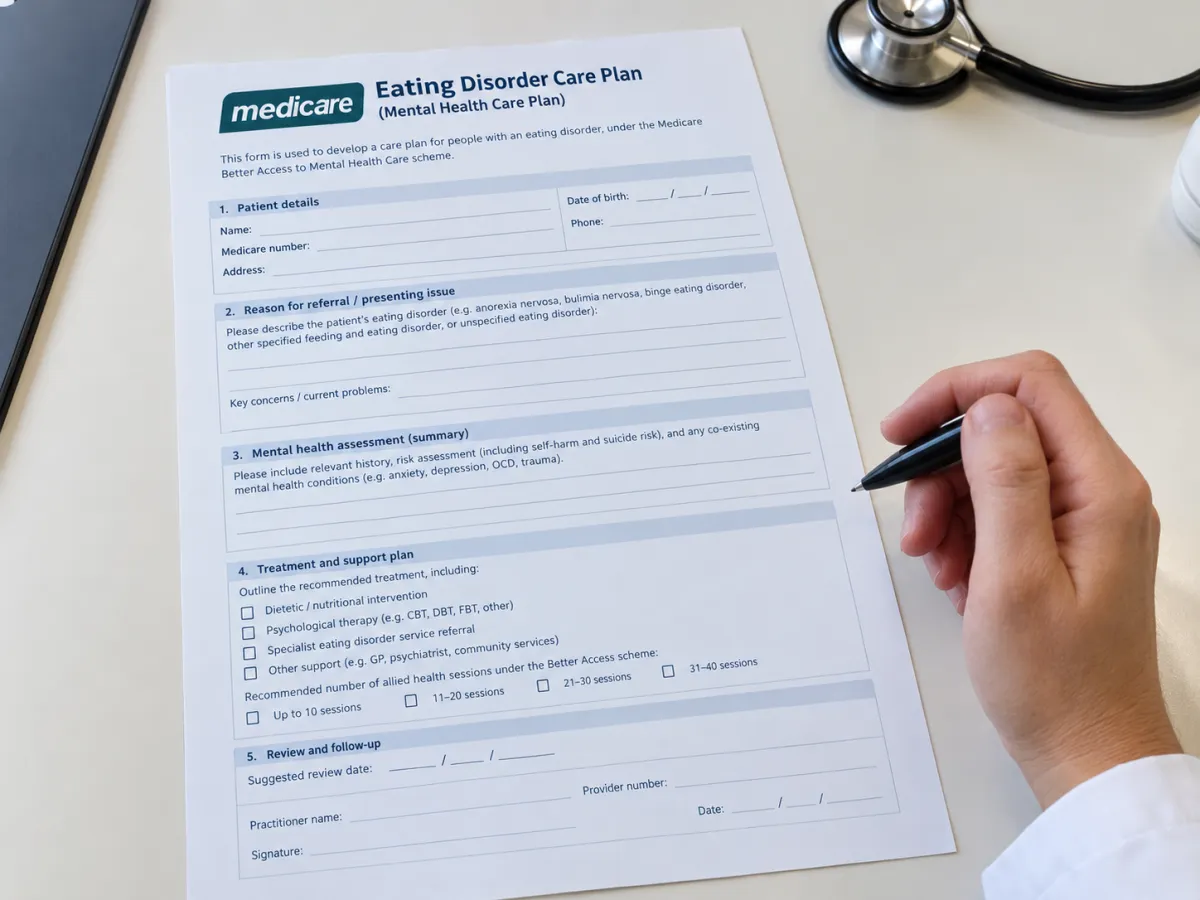
An EDP (sometimes called an Eating Disorder Treatment and Management Plan) is a Medicare initiative that subsidises treatment for people with eating disorders.
Once you have one in place, you have access to:
Up to 20 dietetic sessions (with an Accredited Practising Dietitian like us) over a 12-month period
Up to 40 psychological treatment sessions (with a psychologist or accredited mental health social worker) over the same 12 months
This is a more extensive step up from a standard Mental Health Treatment Plan (MHTP) or GP-managed Chronic Condition Management Plan (GPCCMP).
A few things worth knowing:
After 20 psychological sessions, Medicare requires a review by a medical officer (e.g. GP) before you can access the remaining sessions, up to the 40-session cap.
The plan runs for 12 months from the date it’s created (e.g. if you start the plan on 12th July, it will be eligible until 11th July the next year)
If you still meet the criteria after the 12-month period, it can be renewed, and access all the rebate again.
Medicare provides a rebate based on the health professional in a private and community setting, not a full coverage. Most practices that are experienced in eating disorder will charge a gap fee.
Once your out-of-pocket cost for out-of-hospital service reaches the Extended medicare Safety Net (EMSN) threshold per calendar year (i.e. 1st Jan to 31st Dec), medicare will cover up to 80% of any further gap fee for your private health services that are under an eligible care plan
Who’s eligible?
There are 2 generally 2 pathways to obtaining EDP:
If you have a clinical diagnosis of Anorexia Nervosa (both restrictive or binge-purge subtype), you are automatically eligible for EDP
For other diagnoses (BN, BED, OSFED), eligibility depends on meeting a severity threshold:
Scoring 3 or higher on the Eating Disorder Examination Questionnaire (EDE-Q), a self-report tool your GP or clinician can administer.
Meeting at least 2 of the following indicators:
Rapid or significant weight loss
binge eating or compensatory behaviours occurring 3+ times a week
Body weight below roughly 85% of what’s expected for you
high risk of, or current, medical complication related to the eating disorder
Serious co-ocurring medical or psychological conditions significantly affecting your health
Do I need a formal eating disorder diagnosis?
Not necessarily. Your GP, paediatrician or psychiatrist can make the diagnosis as part of the EDP assessment - you don’t need to have seen a specialist beforehand or arrive with paperwork to ask your medical provider for an eating disorder care plan.
How do I get access to the EDP?
Book a long appointment with your GP, and mention upfront that you’d like to be assessed for an Eating Disorder Plan or request for a long appointment, as an assessment will require more than a regular 10-15 minute appointment.
Your GP will talk through your symptoms, and run through the EDE-Q. If you don’t have a regular GP, we recommends looking for one who lists mental health or eating disorder as an area of interest.
If you meet the requirement for Eating Disorder Plan, you will receive your plan.
It’s recommended to have assemble a team of health professionals that are experienced in eating disorders and disordered eating. A core care team usually include GP, accredited practising dietitian, and a certified mental health professionals (e.g. clinical psychologist) and other health professionals that can support your health.
Engage regular review with your care team. In eating disorder recovery, attending your appointments is a part of the prescription, as it helps you address difficult times and behaviours. With that said, the frequency of contact can be discussed with your health professionals.
When you reach 20 psychological sessions of the year, you will need to see your medical provider (GP or paediatrician) to access further sessions up to the 40 sessions/ year cap.
If your GP isn’t very familiar with eating disorders (which is very common, as it’s a very specialised area), it can help them to make decision by:
be specific and honest about your symptoms - especially around behaviours, distress and self-talk around food, eating and body, including frequency of behaviours, not just “how you’re doing generally”
Mention the EDP by name and ask them to assess you against the criteria
Prepare a symptom and behaviour diary or notes if you find it hard to summarise things verbally or to recall on the day.
If your GP assesses you and doesn’t think you meet the criteria, you’re entitled to a second opinion from another provider.
Who’s on your treatment team?
An EDP is built around treatment team, not a single practitioner, as eating disorder is a complicated bio-psycho-social conditions.
According to National Eating Disorder Collaboration (NEDC), your core treatment team includes:
A medical provider (GP, paediatrician, psychiatrist) - assesses eligibility, manage medical complication, coordinate the team
An eating disordered trained dietitian - heal relationship with food and body, address food and eating behaviours and myths around food, eating, body and metabolism.
A psychologist or accredited mental health social worker - work on the psychological drivers, co-existing mental health difficulties, build emotional and psychological flexibilities and assist with social arrangements
Other health professionals that’s required to support your health, e.g. physiotherapist, occupational therapist, gastroenterologist, nurses, peer support, etc.
If you’re building a treatment team, read our blog on Binge Eating Treatment & Find a Provider
What does the dietitian actually do?
People often confuses why dietitian is in the core treatment team with an assumption that dietetic session are about meal plan and caloric target. We go into this in more details in What Do Dietitians Do In Eating Disorder Recovery?
Broadly, in EDP, dietitians work on your care both in sessions and outside of session.
In sessions, your dietitian typically:
Explore your medical and nutrition history, including your relationship with your body, appearance and weight, biochemistry, symptoms (e.g. gut symptoms, sleep, appetite, energy levels, menstrual cycle), current and past dietary intake, movement patterns, and any rules and thoughts driving these behaviours
Provide nutrition psychoeducation on topics like calories, metabolic adaptation, starvation, and binge and purging behaviours
Work through specific challenge collaboratively and systematically
Adjusts pace and focus session to session based on where you’re at and tackle obstacles to making changes
Outside of session, with your consent, your dietitian will support you through:
Formulating a plan based on your medical considerations, nutrition status, relationship with food, and personal lifestyle and preferences
Reporting progress back to your GP on your initial assessment, as we progress, when major issues arise and at the end of each EDP
Liaising with your psychologist so nutrition and psychological treatment are pointing in the same direction rather than working against each other
Providing between-session resources — handouts, food records or reflection tools, structured eating guides — tailored to what you're working on
Depending on the service, they might provide a point of contact if something comes up between sessions that affects your eating (a medical appointment, a stressful event, a relapse into old patterns)
The detailed work mix shifts depending on your diagnosis, arrangement, preference, history of disordered eating and where you are in treatment.
If you’d like to learn how a dietetic intervention looks like for your eating concerns, feel free to leave a message or talk to our dietitian directly by booking a discovery call.